
September News: Risk, Readiness & the Digital Relationship
This month, we look at the risks and technology shifts shaping Canadian credit unions, including changing digital banking expectations and the upcoming launch of InfoGo.

Industry News
Market and industry developments for Canadian credit unions.
FINTRAC Enforcement Puts AML Execution Under the Spotlight
On September 24, FINTRAC announced administrative monetary penalties against some Canadian credit unions following separate compliance examinations. The findings varied between institutions and included issues related to written compliance policies and procedures, money laundering and terrorist financing risk assessments, suspicious transaction reporting and ongoing monitoring.
One of the clearest lessons from the enforcement notices is the distinction between having a policy and consistently applying it in practice. In one case, FINTRAC found that documented procedures existed but were not adequately followed, with deficiencies in ongoing monitoring records, including missing beneficial ownership information, incomplete client risk updates and gaps in documenting enhanced measures for higher-risk clients.
That matters because compliance programs are increasingly judged not only by whether policies have been written, but by whether institutions can demonstrate that those policies are being carried out through real processes, records and decisions.
At the same time, the Canadian Credit Union Association reported in September that federal officials are exploring a more risk-based approach to parts of Canada's AML framework, with the goal of reducing unnecessary compliance burden while maintaining effectiveness.
For credit unions, those two developments are worth considering together. Effective compliance does not necessarily mean adding more controls. It means making sure the controls that matter are clearly understood, appropriately risk-based and consistently executed.
Why it matters: A compliance policy is only as strong as its implementation. Periodic testing of real workflows can help uncover gaps that may not be visible in written procedures alone.
Sources: FINTRAC, Public notice of administrative monetary penalties | CCUA, Federal officials signal a more risk-based approach to AML compliance
Rates Stay Put, but the Outlook Gets More Complicated
The Bank of Canada held its policy interest rate at 2.25% on September 2, but the decision came with a more uncertain economic outlook. Canadian growth and inflation had been evolving broadly in line with the Bank's July forecast, while persistent energy costs, new U.S. tariffs and Canadian counter-tariffs increased both inflation risks and uncertainty around economic growth.
Headline CPI inflation had been hovering around 3%, driven largely by gasoline prices. Excluding gasoline, inflation was 2.2% in July, while measures of core inflation remained close to 2%.
The challenge for the Bank is that the risks are moving in different directions. Higher energy and trade costs could put upward pressure on prices, while broader uncertainty may weigh on business investment and economic activity.
For credit unions, a steady policy rate does not necessarily mean a steady operating environment. Interest rates continue to influence borrowing demand, mortgage renewals, deposit pricing and member affordability, while business members may also be navigating higher input costs and uncertainty around trade.
That makes the environment less about reacting to a single rate announcement and more about understanding how different groups of members are being affected. The next scheduled Bank of Canada rate decision is October 28.
Why it matters: Stable rates can provide some predictability, but credit unions still need to watch the conditions behind the headline number. Member affordability, credit performance and business confidence can move even when the policy rate does not.
Source: Bank of Canada, September 2 interest rate announcement
Digital Banking Is Becoming a Loyalty Issue, Not Just a Service Channel
Keeping a member's primary account does not necessarily mean keeping their entire financial relationship. New Canadian research from Environics highlights just how fluid those relationships are becoming.
In a spring 2026 survey of more than 42,000 Canadians, 46% said they had opened at least one new financial product during the previous 12 months. While 24% stayed with their primary financial institution, another 22% opened a product with a different provider.
The shift becomes particularly important when the new product is a chequing account. Among chequing switchers in the study, 52% also changed their primary financial institution.
Digital banking is helping lower the barriers that once made switching inconvenient. Digital onboarding has improved, competing offers are easier to compare and more of the process can now be completed online. That changes the role of the digital channel from a convenience feature into a more important part of the overall member relationship.
A mobile or online banking experience is no longer simply a way for members to check balances and move money. Price still matters, but the research found that Canadians also place significant value on information security, transparency, low fees and ease of account management.
Earlier Canadian digital banking research from J.D. Power reinforces the importance of getting the fundamentals right. System performance, design, useful information and practical digital capabilities remain core parts of the experience.
For credit unions, that makes digital banking both a service channel and a relationship channel. A member can remain technically "retained" while gradually moving lending, investments or everyday banking elsewhere.
Why it matters: As switching becomes easier, digital experience can influence more than satisfaction. It can affect which institution earns the member's next product and ultimately maintains the primary relationship.
Sources: Environics Research, The Great Canadian Banking Shift | J.D. Power, 2026 Canada Digital Banking & Credit Card Satisfaction Studie

Tech Trends
Insights shaping the future of Canadian credit unions.
Building Resilience Across the Technology Ecosystem
Modern financial services depend on an increasingly connected technology ecosystem. Core banking platforms, digital banking, payment services, cybersecurity tools, cloud infrastructure and integrations can involve multiple internal systems and external technology partners working together.
As those environments become more interconnected, operational resilience increasingly depends on understanding critical technology dependencies and how disruptions would be managed.
Canadian financial regulators continue to place greater attention on operational resilience and third-party risk. The focus is not simply on reducing the use of external providers. Specialized technology partners are an essential part of modern financial services. The priority is making sure institutions understand which services support critical operations, how disruptions would be managed and how responsibilities are shared between the institution and its providers.
For credit unions, that means maintaining clear visibility into critical technology relationships, recovery expectations, data access, escalation processes and business continuity plans.
Strong resilience is ultimately collaborative. Financial institutions and their technology partners both have a role in making sure critical services remain secure, reliable and recoverable when something goes wrong.
Why it matters: As banking technology becomes more interconnected, resilience increasingly depends on strong processes and clear coordination across the entire technology ecosystem.
Sources: OSFI, Annual Risk Outlook 2026–2027 | OSFI, Third-Party Risk | Bank of Canada, Financial System Survey Highlights 2026
Beyond Passwords: Why Passkeys Are Gaining Ground
Passwords have been one of the weakest links in digital security for decades. They can be reused, stolen, guessed or captured through phishing, while some forms of multifactor authentication can still be vulnerable to social engineering.
Passkeys take a different approach. Instead of relying on a reusable password, they use public-key cryptography, with a private key protected on the user's device and a corresponding public key held by the service. The user can then authenticate using the security already available on the device, such as a PIN or biometric verification.
One of the biggest advantages is phishing resistance. Because there is no reusable password for a member to accidentally provide to a fraudulent website, one of the most common attack paths becomes significantly more difficult.
The Canadian Centre for Cyber Security describes passkeys as a strong, phishing-resistant authentication mechanism, but also warns that implementation requires careful planning. Not every device or application supports them, cross-device experiences can create usability challenges, and organizations still need strong device security and account recovery processes.
That last point is particularly important for financial institutions. Authentication cannot be evaluated only by how secure the login screen is. Institutions also need to consider what happens when a member changes phones, loses access to a device or needs to recover an account.
For credit unions, passkeys are worth watching because they address two priorities that do not always work comfortably together: stronger authentication and a simpler digital experience.
Why it matters: Passkeys could reduce reliance on passwords and strengthen phishing resistance, but the member experience around device changes, recovery and support will be just as important as the authentication technology itself.
Source: Canadian Centre for Cyber Security, Cyber security considerations for passkeys

Tip of The Month
Practical guidance for credit unions
Test the Process, Not Just the Policy
A policy can look complete on paper and still break down when it reaches a real workflow.
This month, choose one high-risk operational process and test it from beginning to end.
It could be suspicious transaction escalation, ongoing member monitoring, privileged system access, account recovery or another process where documentation and execution both matter. Take a real or appropriately anonymized case and compare what actually happened with what the procedure says should happen.
Look for:
steps that were skipped or handled differently
information that was not recorded
manual workarounds outside the normal system
unclear ownership between teams
approvals that cannot easily be traced
procedures staff interpret differently
The objective is not to find someone to blame. It is to find the difference between the process you designed and the process people actually use. Policies tend to change more slowly than technology, staffing and day-to-day operations. Periodic testing can reveal where those two realities have started to separate.
Tip: Pick one process this month. Follow one case all the way through. If you cannot easily demonstrate who did what, when and why, there may be a control worth reviewing.

Infonancial Updates
Brief notes from our team
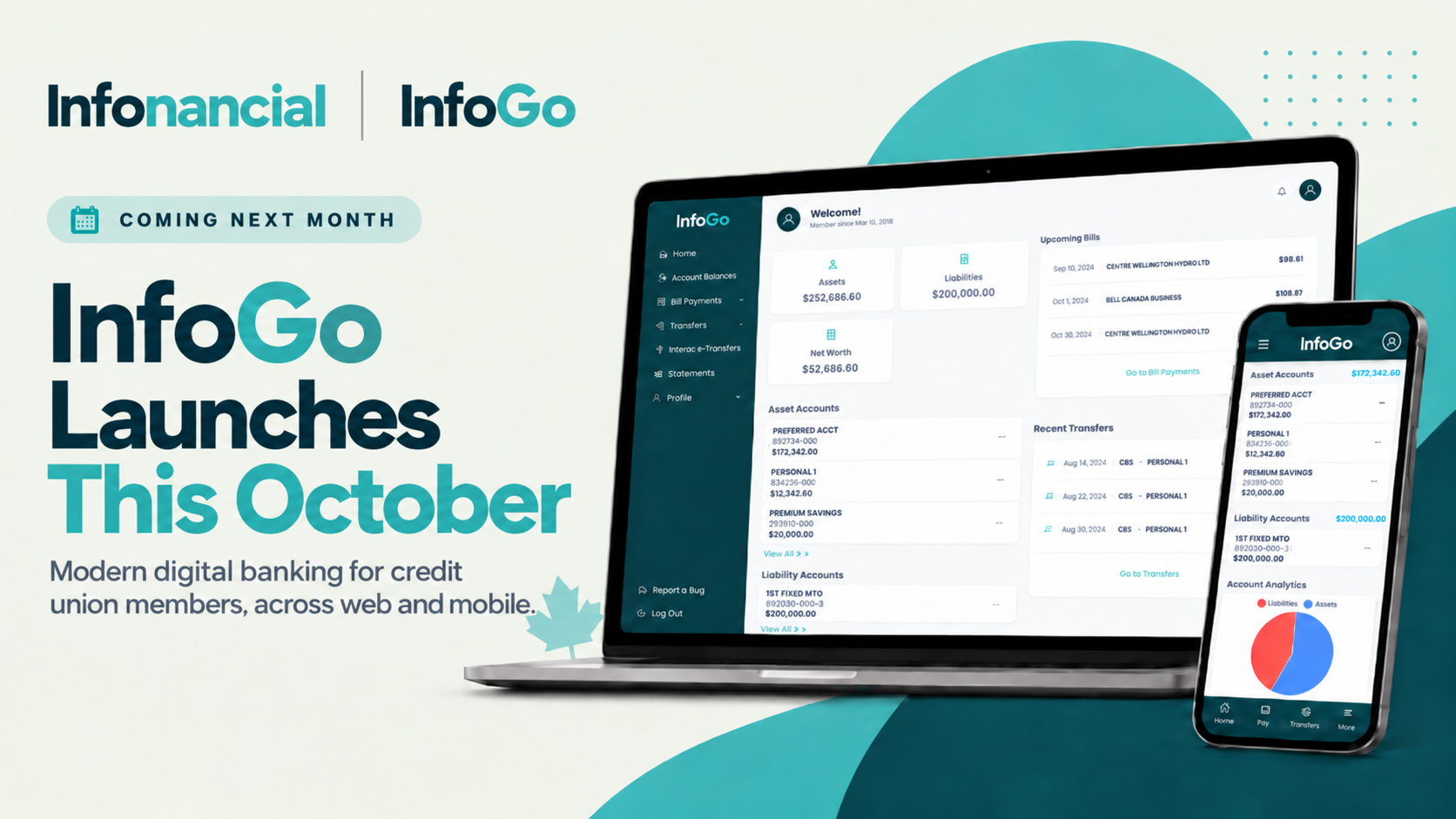
InfoGo is Coming this October
Infonancial is adding a new piece to its ecosystem. InfoGo is our digital banking platform, designed to give credit union members a modern, seamless way to manage their everyday banking across web and mobile.
This October, InfoGo will go live with its first credit union, marking an important milestone and the beginning of a new chapter in how we support the members our partners serve.
Want a closer look at what’s coming? Contact us to book a demo or ask our team any questions about the platform.
Connecting with the Credit Union Community at the OCUF Golf Classic
This month, our team was proud to be part of the OCUF 35th Annual Golf Classic, joining credit union leaders, partners and community members for a day of connection and conversation. Events like this matter because they bring the credit union community together outside the usual day-to-day work. They create space to strengthen relationships, share ideas and support initiatives that have a broader impact across the sector.
We were especially pleased to support an event that also helps advance the work of the Ontario Credit Union Foundation, including its efforts in youth education and leadership.
It was a great opportunity to reconnect with familiar faces, meet new ones and spend time with the community we’re proud to serve.